
Kazuma Koike 小池一馬


Born in 1980 in Kanagawa, Japan. Lives and works at Osaka.
Koike spent his childhood in Buenos Aires, Argentina, attended a high school in Barcelona, Spain, and graduated from the Department of Sculpture, College of Art at Nihon University. The works of Spanish sculptor Josép Clarà has inspired him to follow suit. Growing up in a multi-cultural environment, Koike is interested in “Shinbutsu-Shugo”, a mix between Japan's native Shinto beliefs and Chinese Buddhism. Koike visited numerous temples where their architecture, gardens, and sculptures became his inspiration.
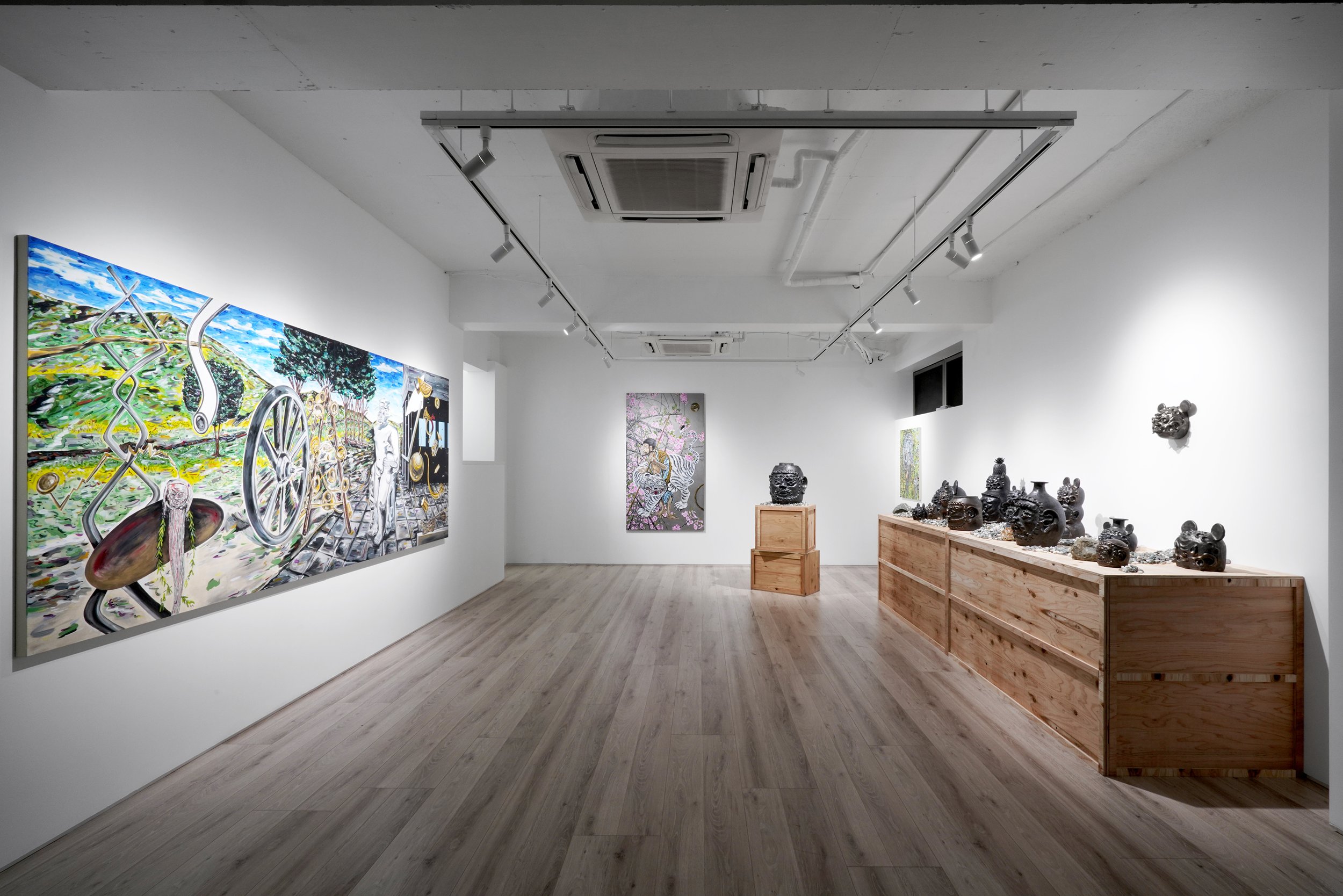
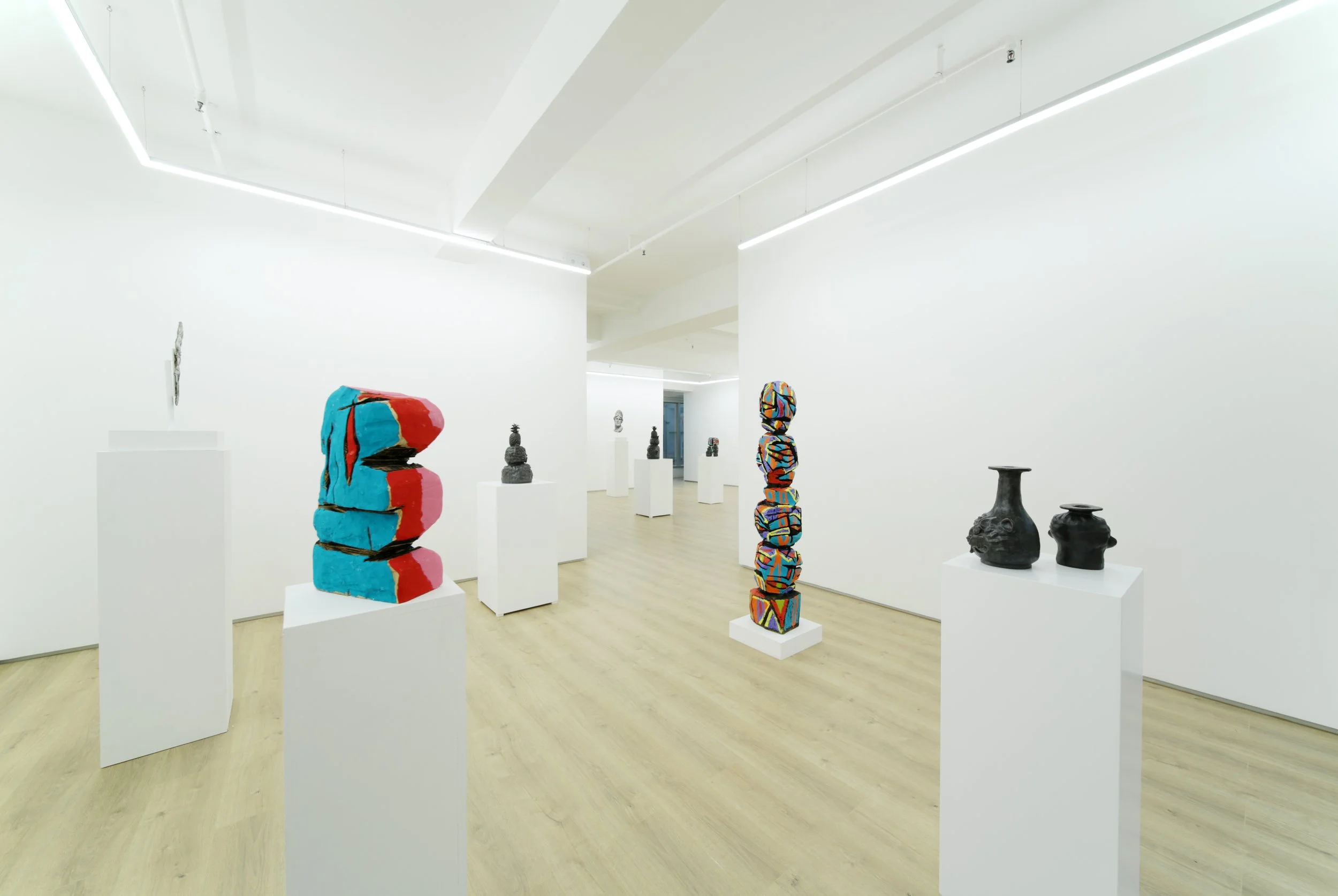
Koike started his first attempt of deconstructionism sculpture by compiling various dismantled found objects, removing their physical meaning, and reforming into a sculpture. In the recent decade, Koike created most artworks by mixing images from different space and time, creating “fictional ancient artifacts” as if they do not belong to any era of the recorded history. Motifs of divinity, big cats, plants and pineapples are repeatedly appears in Koike’s works, among them, the element of big cats are inspired by the tiger paintings of Japan's Edo period — there was no tiger in Japan at that time. Tiger paintings then were imaginary creatures made with reference to chinese paintings, furs brought back and cats. Koike always aims at the state where “different elements coexist in harmony”. He once joked that future scholars from 2000 years later will discover a whole new culture from my buried works.
The artist attempts to present his works as if they were found objects, hence his creations are mostly spontaneous. Black clay and special black glaze are applied to simulate the color of traditional Japanese tea sets. Most of Koike’s sculptures are titled in codes — “BC” stands for “Black Clay”, and numbers are the date finished modeling - Koike avoids any narrative in the work titles, so that one could interpret his work from a more detached perspective purely on the basis of its physical form.
1980年出生於日本神奈川縣。
小池一馬於阿根廷布宜諾斯艾利斯度過了他的童年,並在西班牙巴塞羅那完成高中學業,從西班牙雕塑家Josép Clarà的作品獲得啟發去製作雕塑,後畢業於日本大學藝術學部雕塑系。受其多元文化的背景影響, 小池熱衷於日本神道信仰和漢傳佛教折衷的「神佛習合」。他曾走訪各個不同的寺院,當中的建築、園藝、和雕塑都成為了他的創作靈感。
在創作初期,小池嘗試以各種現成物的部件拼湊出一件雕塑 ― 消解了物品本來的意義,單純以藝術的角度重組,是他對解構主義的嘗試。而近年他把不同地點和時期的影像混合創作「虛構的古器物」,賦予作品一種不屬於任何時空和地域的獨特漂浮感。神靈、大型貓科動物、植物和菠蘿幾種元素常常被混合使用,其中大型貓科動物的選用源於日本江戶時代的虎圖 ― 其實當時的日本還沒有老虎。 這段時期的虎圖是參考從中國傳入的畫作和毛皮、結合貓的姿態創作而成的想像。小池一直追求着「不同元素和諧共存的狀態」,曾經笑言假若他的作品被埋到土裏,希望2000年後的學者會從他的作品中考古出一個全新的文明。
小池希望他的雕塑能在不經意間展示現成物(Found Object)的觀感,因此多以充滿偶發性的陶瓷為主。他選用黑土和黑灰釉,令作品呈現日本傳統茶具的色澤。這些雕塑作品多以代碼為題,「BC」代表「黑色陶瓷(Black Ceramic)」、數字則是完成塑形的日期 — 小池避免在命題中賦予敘事,期望觀者可以更客觀、抽離地欣賞其作品之形態。
PREVIOUS EXHIBITIONS




-
2024
Fish Scales and Tiger Dreams | The Fridge | New York, NY, United States
Paintings and Sculptures | Sokyo Annex | Kyoto, Japan
In the Year of the Dragon: with Jordy Kerwick | AISHONANZUKA, Hong Kong2023
Djordje Ozbolt and Kazuma Koike: with Djordje Ozbolt | AISHONANZUKA | Hong Kong
Prayer | Galerie Julien Cadet | Paris, France
Stille: with Henrik Godsk | HAGD Contemporary | Aalborg, Denmark2022
KOISHI-KEI: with Toru Ishii | Sokyo Gallery | Kyoto, Japan2021
Cama: with Shuhei Yamada | Mitsukoshi Contemporary Gallery | Tokyo, Japan
Kazuma Koike| OMURO MUSEUM | Mie, Japan2020
Solo Exhibition | Tezukayama Gallery | Osaka, Japan2019
Solo Show | AISHONANZUKA | Hong Kong
Cama | with Shuhei Yamada, Vou | Kyoto, Japan2017
Buddha Blues | Tezukayama Gallery | Osaka, Japan2016
In a Thicket | A&D Gallery | Nihon University College of Art, Tokyo, Japan
Volta 12 | Markthalle Basel | Tezukayama Gallery, Basel, Switzerland
Volta NY | PIER 90 | Tezukayama Gallery | New York, NY
Eclipse | AISHONANZUKA , Hong Kong2014
Neutral Palm Square | Tezukayama Gallery | Osaka, Japan2013
Hermit and Bottled Water | AISHONANZUKA | Hong Kong
Float | Aisho Miura Arts | Tokyo, Japan2012
Hallucinations | Aisho Miura Arts | Tokyo, Japan2011
Repetitions and Variations | Aisho Miura Arts | Tokyo, Japan2010
The quest | Aisho Miura Arts | Tokyo, Japan
A silent moment at Veronica island | with Yasuyoshi Botan | hpgrp Gallery Tokyo, Japan
Blinks | hpgrp Gallery Tokyo | Tokyo, Japan2009
Trance | Aisho Miura Arts | Tokyo, Japan -
2024
Fugue for Crocodiles | MIKADO2* | The Triangle | Kyoto City KYOCERA Museum of Art | Kyoto, Japan
Yukukawanonagarehataezushite | MIKADO2* | Kyoto Tsutaya Books | Kyoto, Japan
Chimeric Sculpture Expression | AKI Gallery | Taipei, Taiwan
Bright Light | HAGD Contemporary | Aalborg, Denmark2023
Cama | Mitsukoshi Contemporary Gallery | Tokyo, Japan
BLACK | puls contemporary ceramics | Brussels, Belgium
Kuroobianaconda 05 Sukiyaki | AISHONANZUKA | Hong Kong
Solidaholic | Tezukayama Gallery | Osaka, Japan
Twice Upon A Time | GALLERY 46, SR Gallery | London, UK & Brussels, Belgium
Inception | HAGD Contemporary | Aalborg, Denmark2022
INTERSECTION | AISHONANZUKA | Hong Kong
KUROBIKARI | THE SHOPHOUSE | Hong Kong
MIKADO2 - My baby collection | Tezukayama Gallery | Osaka, Japan
Kuroobianaconda 04 Temporas | Sokyo Lisbon | Lisbon, Portugal
End of Eden | Galerie Wolfsen | Aalborg, Denmark
TOKYO NIGHTS VOL.4 | BLOCK HOUSE | Tokyo, Japan
TOKYO NIGHTS VOL.3 | BLOCK HOUSE | Tokyo, Japan2021
Hello Konnichiwa | AISHONANZUKA | Hong Kong
Kuroobianaconda 03 Sanmaioroshi | Tezukayama Gallery | Osaka, Japan
Mikado2 | Zuiun-an | Kyoto, Japan
Re: Focus vol.5 | Tezukayama Gallery | Osaka, Japan2020
Kuroobianakonda 02 Wagiri | The 5th Floor | Tokyo, Japan2018
Re: Focus Vol. 3 | Tezukayama Gallery | Osaka, Japan2017
Enokojima Art Days 2017: Other Ways | enoco | Osaka, Japan2015
Waxing and Waning | hpgrp Gallery Tokyo | Tokyo, Japan2013
Gallery Show| AISHONANZUKA | Hong Kong2012
Hell / Summer / Landscape | Aisho Miura Arts | Tokyo, Japan2011
Group Show 2 | Aisho Miura Arts | Tokyo, Japan2010
Group Show 1 | Aisho Miura Arts | Tokyo, Japan
The 5th Daikokuya Contemporary Art Award Exhibition | Daikokuya | Tochigi, Japan
No Man's Land | French embassy | Tokyo, Japan2009
Showcase | Aisho Miura Arts | Tokyo, Japan2008
Japan Now | Inter Alia Art Company | Seoul, South Korea2007
Casino Royale | SCAI THE BATHHOUSE | Tokyo, Japan